
Release of key macroeconomic numbers, monthly derivatives expiry, and global cues are likely to drive stock market movement this week, according to analysts. Markets will also be reacting to remarks made by the US Federal Reserve Chair Jerome Powell, they said. "This week, we expect the market to witness a gradual up-move with stock-specific action.

Most of the lenders had informed their customers in advance about the strike call given by All India Bank Employees Association (AIBEA), All India Bank Officers' Association (AIBOA), BEFI, INBEF, INBOC and Bank Karmachari Sena Mahasangh (BKSM), and its impact on banking services.

'If the US stagnates and falls into a recession, the dollar will weaken, oil prices will also dip. This augurs well for India.'

The Reserve Bank of India on Wednesday decided to keep the policy rate unchanged for the tenth time in a row but changed its stance to 'neutral' that may lead to a cut in the forthcoming policies. RBI maintained status quo despite the US Federal Reserve lowering the benchmark rates by 50 basis points last month.

After outperforming the broader market and their public sector peers for the better part of the post-Lehman period, private sector banks - such as HDFC Bank, ICICI Bank, Axis Bank, and Kotak Mahindra Bank - are now underperforming. Last week, the Nifty Private Bank index was up just 6 per cent year-to-date in the calendar year 2021, against nearly 13 per cent rally in the Bank Nifty and a 15 per cent rise in the benchmark Nifty50. Public sector (PSU) banks, such as State bank of India, Bank of Baroda, and Punjab National Bank, are now rally leaders and outperforming the broader market. The Nifty PSU Bank index was up 42 per cent since the beginning of this calendar year. But on a longer term, the Nifty Private Bank index is up 101 per cent since March 2016, against a 118 per cent rally in the Bank Nifty and just 2 per cent rise in the Nifty PSU Bank index in the period.

Reflecting strong momentum in business, commercial banks, including one public sector lender, reported a year-on-year (YoY) growth in advances. This was higher than or around the banking sector trend in the first quarter ended June 2023. Bank of Maharashtra said its loans expanded by 25 per cent YoY to Rs 1.75 trillion. This pace was much higher than the banking system's 15.4 per cent growth till June 16, 2023, according to Reserve Bank of India (RBI) data.

A trends study conducted by India's Financial Intelligence Unit (FIU) has expressed suspicion that cryptocurrency is being used across the country in serious criminal acts like terrorist financing, fuelling secessionist activities, cybercrime, narcotics trafficking, illegal betting and gambling. The report, which was based on suspicious transaction reports and operational analysis, shared these trends and credible intelligence with law enforcement agencies.
Global fund managers remain bullish on the Japanese stock markets, which is now their most preferred destination in the Asian region. Both Morgan Stanley and Jefferies in their recent reports, have cited their preference for the Land Of The Rising Sun, which is fast becoming the land of the rising equities, too.

After a robust 2023, foreign investors significantly scaled back their investments in Indian equities in 2024, with net inflows amounting to over Rs 5,000 crore, as elevated domestic valuations, coupled with geopolitical uncertainties prompted investors to adopt a more cautious stance. Looking ahead to 2025, FPI flows into Indian equities could see a recovery, supported by a cyclical upswing in corporate earnings, particularly in domestic-oriented sectors like capital goods, manufacturing, and infrastructure, Vinit Bolinjkar, head of research, Ventura Securities, said.

'Higher interest rates make gold less attractive as it doesn't generate yield.' 'However, with rates set to fall, the tables are turning for gold.'

When evaluating bonds, returns shouldn't be the sole factor. Pay close attention to the bond's credit rating. It should ideally be AA or higher.

Foreign investors pulled out Rs 4,285 crore from Indian equities in the first three trading days of the month driven by apprehensions ahead of the third-quarter earnings season and high valuations of domestic stocks. This came following an investment of Rs 15,446 crore in the entire December, data with the depositories showed.
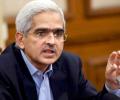
The December meeting of the Reserve Bank of India's (RBI's) six-member Monetary Policy Committee (MPC) will start on Wednesday even as there is no clarity on whether Governor Shaktikanta Das, the chair of the panel, will continue in office after his term ends next week. The outcome of the meeting will be announced on Friday by Das at 10 in the morning.

The three day MPC meeting began on Monday and the decision will be announced on Wednesday by RBI Governor Shaktikanta Das.

The US Federal Reserve's interest rate decision, global market trends and trading activity of foreign investors are the major factors that would dictate terms in the equity markets in a holiday-shortened week ahead, analysts said. Equity markets will remain closed on Tuesday on account of Ganesh Chaturthi. From the global front, interest rate decisions from the Bank of England and Bank of Japan would also influence market trends.

Among the Sensex firms, Tech Mahindra, HCL Technologies, Wipro, Infosys, Bajaj Finance, Tata Consultancy Services, Bajaj Finserv and ICICI Bank were the major gainers. Power Grid, Nestle, Asian Paints and Hindustan Unilever were among the laggards.

Foreign portfolio investors (FPIs) sold shares worth Rs 20,170 crore ($2.4 billion) recently. This marked the fifth-highest weekly outflow from overseas funds since the beginning of 2008 and the largest since the last week of March 2020. Due to the Covid scare, FPIs had sold shares worth Rs 21,951 crore during that week, causing the market to decline by nearly 20 per cent.

The announcement of the Federal Reserve sent markets to a tizzy

This was Rana's last legal chance not to be extradited to India. Earlier, he lost a legal battle in several federal courts, including the US Court of Appeals for the North Circuit in San Francisco.

Many banks' profits will take a hit and a few of them could even end up being in the red because of treasury losses, triggered by a sudden spike in government bond yields in the rising interest rate cycle, notes Tamal Bandyopadhyay.

The Sensex pull-back was mainly staged by constant selloffs in banking shares, led by ICICI Bank, Axis Bank and IndusInd Bank. Of the Sensex constituents, 19 shares suffered losses.

'When interest rates rise, the NAVs of these funds will fall.' However, they won't fall as much as longer-duration funds.

State Bank of India (SBI), India's largest lender, is looking to raise Rs 10,000 crore through 15-year infrastructure bonds as early as next week, said multiple sources aware of the development. Market participants expect a coupon in the range of 7.15-7.18 per cent for SBI's upcoming infrastructure bond issuance. This comes as demand for longer-tenor papers has remained strong in recent domestic capital market offerings.

Traders broadly expect the rupee to stay in a 61.50 to 63.50 range over the next three months.

The rupee has depreciated 9.7 per cent against the US dollar over a year and with the RBI stemming the rupee's weakness through dollar sales, its reserves have dropped to their lowest levels since October, 2020. The fall in reserves has widespread implications.

Reserve Bank governor Shaktikanta Das on Friday cautioned banks against any build-up of asset-liability mismatches, saying both are detrimental to financial stability and hinted that the ongoing crisis in the US banking system seems to have emanated from such mismatches. Delivering the annual KP Hormis (Federal Bank founder) commemorative lecture in Kochi this evening, the governor was quick to acknowledge and assure that the domestic financial sector is stable and the worst of inflation is behind us. Amid the continuing volatility in exchange rates, especially due to the excessive appreciation of the US dollar, and its impact on the external debt servicing ability of nations, Das said, "We have nothing to fear as our external debt is manageable and thus appreciation of the greenback does not pose any problem to us."

The net credit card additions in the banking sector nearly halved to 2 million in the first quarter of the current financial year (Q1FY25) from the previous quarter due to seasonal and regulatory factors. According to the Reserve Bank of India (RBI) data, the net credit card additions during the April-June quarter of FY25 stood at 2 million, 48 per cent lower than 3.9 million in the December-March quarter of FY24.

India may adopt norms similar to the US Federal Reserve model, which regulates conglomerate-led banks in the country.

A combination of strong earnings and economic growth, and hopes of the Federal Reserve ending the rate-hike cycle have pushed gross buying of Indian equities by foreign portfolio investors (IPO) to a new high. In 2023, FPIs have been gross buyers of shares worth Rs 25.5 trillion, the highest ever in a calendar year. FPIs also sold shares worth Rs 23.9 trillion. On a net basis, they were net buyers to the tune of Rs 1.6 trillion, the highest since 2020.

'Investors with foreign currency-denominated goals, such as foreign education or foreign travel, should go for US equity funds.'

In the Sensex pack, Mahindra & Mahindra tanked over 6 per cent after the company cut the prices of its SUV models to boost demand. Mahindra & Mahindra said its XUV700's fully-loaded AX7 range now starts at Rs 19.49 lakh, a price cut of over Rs 2 lakh. Tata Steel, Tata Consultancy Services, HCL Technologies, State Bank of India, JSW Steel, Tata Motors and Kotak Mahindra Bank were other losers.

Fundraising through qualified institutional placement (QIP) has revived this year, led by commercial banks, after a lacklustre 2022. According to data compiled by Prime Database, Indian companies have raised Rs 53,070 crore in 2023 so far, of which seven banks - Union Bank of India, Indian Bank, Bank of India, Federal Bank, IDFC First Bank, Bank of Maharashtra, and J&K Bank - account for Rs 21,290 crore, or about 40 per cent. If other financial institutions are included, the figure surges to Rs 26,690 crore.

'Right now, silver -- and especially platinum -- are very cheap compared to gold. If I were buying today, I would choose platinum.'

ITC was the top loser in the Sensex pack, shedding nearly 3 per cent, followed by Bajaj Finance, Kotak Bank, Bharti Airtel and Reliance Industries. Nifty fell 43.35 points to 17,324.90.

The Sensex and Nifty spiralled lower for the fourth session on the trot on Wednesday as investors remained on edge ahead of US inflation data, which will give clues on the Federal Reserve's policy tightening trajectory. Unabated selling by foreign institutional investors and a jump in crude prices also weighed on sentiment, traders said. Despite a firm start, the 30-share BSE Sensex failed to carry forward the momentum and ended at 54,088.39, lower by 276.46 points or 0.51 per cent. During the day, it tumbled 845.55 points to 53,519.30.
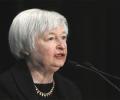
She will replace Ben Bernanke as the Chair of the Federal Reserve.

The bias for the BSE benchmark index, technical charts suggest, is likely to remain bullish as long as the index holds above 75,600 levels for the rest of the year.

A host of macroeconomic data announcements, the last batch of September quarter earnings, global trends, and trading activity of foreign investors will be the major driving factors for the equity market this week, according to analysts. Equity markets would remain closed on Friday for Guru Nanak Jayanti. "India is set to release CPI and IIP data on November 12, with WPI data expected on November 14.
From the Sensex basket, NTPC, Power Grid, IndusInd Bank, Tata Steel, Tata Motors, JSW Steel, Tech Mahindra and Larsen & Toubro were the biggest gainers. Bharti Airtel, Maruti, ICICI Bank and Asian Paints were the laggards.

Net flows from domestic institutional investors crossed Rs 5 trillion for the first time during a calendar year.
